

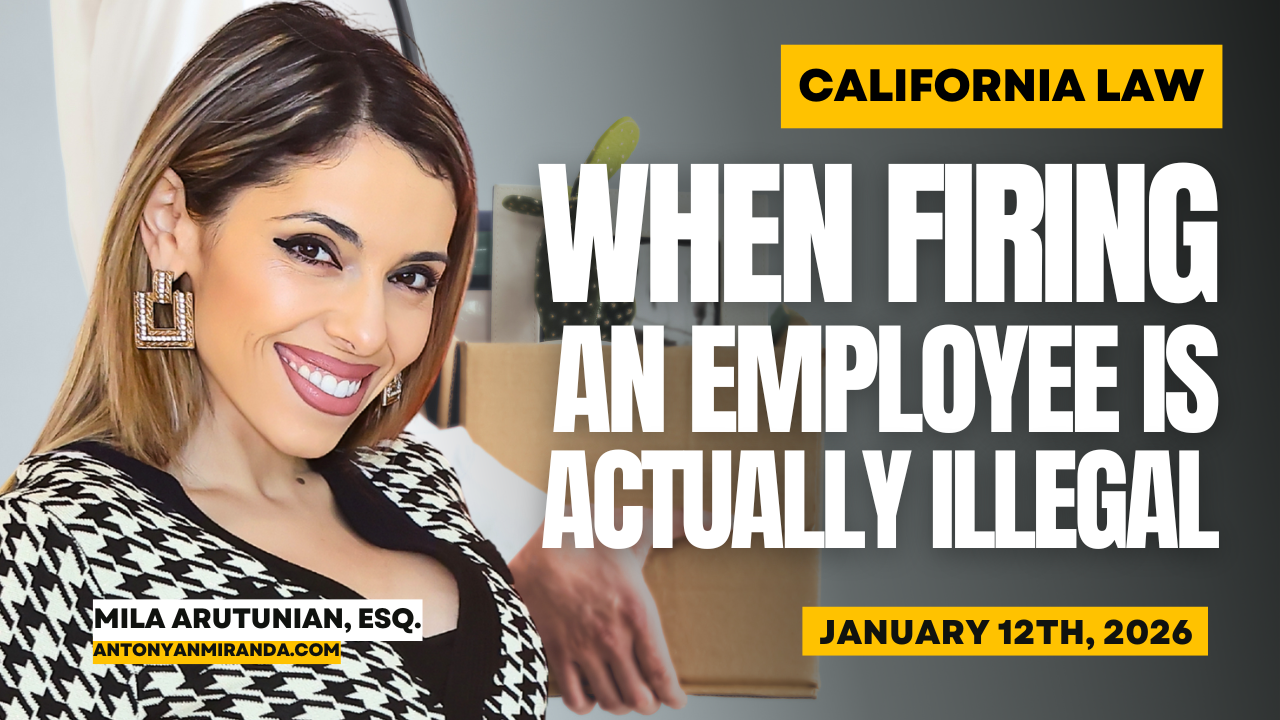
That phrase gets repeated a lot, and it’s only half true.
Yes, California is an at-will employment state. But that does not mean your employer can fire you for an illegal reason. In reality, many employees who are told they were terminated “at will” were actually fired unlawfully.
Let’s break this down in plain English.
“At-will” simply means your employer does not need a specific reason to fire you, and you don’t need a reason to quit.
But here’s the part most people are never told: at-will does not mean no rules apply.
California law places very clear limits on when and why an employer can terminate someone. If those limits are crossed, the termination may be illegal — even if your employer calls it “at-will.”
A termination becomes wrongful when it’s based on a reason the law does not allow.
Here are some of the most common situations we see.
Your employer cannot legally fire you because of protected characteristics, including your gender, pregnancy, sexual orientation, race, ethnicity, disability, medical condition, religion, or age if you are 40 or older.
Employers sometimes try to avoid responsibility by saying, “We didn’t give a reason.” But the real reason still matters. If discrimination played any role in the decision, the termination may be unlawful.
Your employer cannot legally fire you because of protected characteristics, including your gender, pregnancy, sexual orientation, race, ethnicity, disability, medical condition, religion, or age if you are 40 or older.
Employers sometimes try to avoid responsibility by saying, “We didn’t give a reason.” But the real reason still matters.
If discrimination played any role in the decision, the termination may be unlawful.
This is called retaliation, and it happens far more often than people realize.
You cannot legally be fired for reporting harassment or discrimination, complaining to HR about illegal conduct, requesting reasonable accommodations, taking medical, pregnancy, or family leave, reporting unsafe or unlawful practices, disclosing a pregnancy, or filing a workers’ compensation claim.
If you spoke up and then suddenly lost your job, that timing matters.
California has strong laws protecting employees who need time off for serious reasons.
Your employer cannot legally fire you for taking Pregnancy Disability Leave, medical or disability leave, CFRA or FMLA leave, jury duty, or military leave.
If your termination happened right after you requested leave or returned to work, that is a major red flag.
Not every wrongful termination involves being officially fired.
If your employer made your job so unbearable that you felt you had no real choice but to quit, California law may still treat that as a termination. This is called constructive termination.
This can happen through ongoing harassment, retaliation after complaints, sudden demotions or pay cuts, unreasonable schedule changes, or being ignored, isolated, or humiliated at work.
Being “forced to resign” can still be illegal.
Your employer cannot fire you for refusing to break the law, falsify records, lie, cover up misconduct, or participate in discrimination or harassment.
If you were terminated for doing the right thing, the law may be on your side.
Many wrongful termination cases follow the same pattern: An employee has good reviews, then they complain, request leave, or ask for accommodations. Suddenly, negative write-ups appear, expectations change, and termination follows shortly after.
Employers often use “performance issues” as a cover. Courts look closely at timing, consistency, and whether other employees were treated differently.
Most employers don’t admit wrongdoing. These cases are usually proven through patterns and circumstances, such as how close the firing was to a complaint or leave request, vague or changing explanations, emails or text messages, and evidence that similar employees were treated better.
You do not need a “smoking gun” to have a valid claim.
You should consider getting legal advice if you were fired shortly after raising concerns, HR ignored or minimized your complaints, you were pressured to quit, you were offered severance and told to sign quickly, or something about the termination just doesn’t feel right.
Trust that instinct, it may be correct. If you have any questions, please feel free to reach out to me directly at emilia@antonyanmiranda.com.
The Bottom Line
Yes, California is an at-will employment state. But at-will does not mean your employer can break the law. Many terminations labeled as “at-will” are actually discriminatory, retaliatory, or otherwise illegal. Knowing your rights is the first step toward protecting yourself.
Call us at 619-696-1100 to speak with one of our concierge attorneys or visit us or send us an email.








402 W Broadway. Twenty-First Floor
San Diego, CA 92101
Mobile: 619.696.1100
Email: info@antonyanmiranda.com




All rights reserved Antonyan Miranda, LLP 2025 | Disclaimer | Privacy Statement