

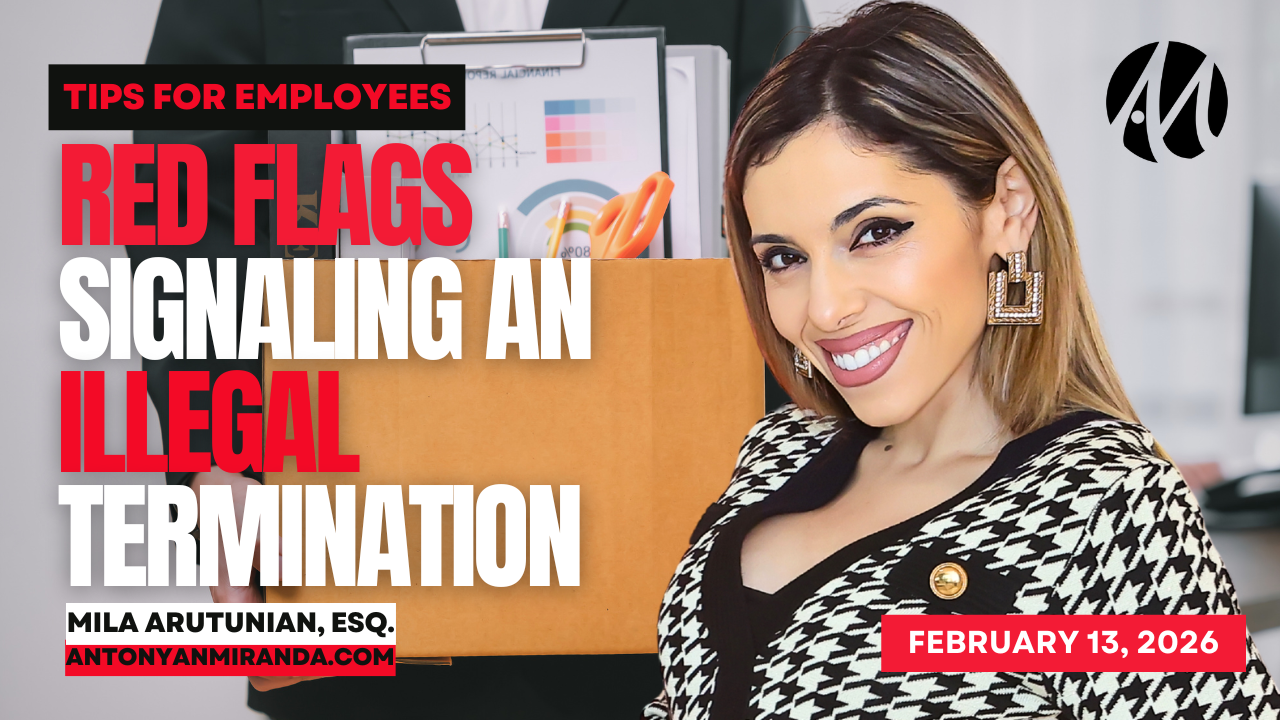
Imagine this-- you were just fired.
Maybe it was quick. Maybe it was awkward. Maybe they handed you a box and walked you out like you were a security threat. And now you’re replaying everything in your head. Was that illegal?
California is an “at-will” employment state — which means employers love to say, “We can fire you for any reason.”
But here’s the part they leave out: They cannot fire you for an illegal reason.
And under California employment law, a lot of “business decisions” are actually unlawful terminations dressed up in corporate language.
If something about your firing doesn’t sit right, here are seven signs you may have been wrongfully terminated in California.
Let’s talk about timing.
Possible Scenarios: You complained about sexual harassment. You reported discrimination. You told HR about unpaid overtime. You asked for accommodations. You reported something shady happening at work.
And then suddenly… you’re the problem.
Your attitude is questioned. Your performance is “concerning.” You’re “not a team player.”
Then you’re fired. That’s not random.
Under California law — including the Fair Employment and Housing Act (FEHA) and Labor Code section 1102.5 — employers cannot retaliate against you for engaging in protected activity.
Protected activity includes complaining about discrimination, harassment, wage violations, or illegal conduct.
If your termination followed your complaint, that’s a giant red flag.
Retaliation is one of the most common wrongful termination claims in California. And juries see right through it.
Possible Scenarios: You were dealing with something real: A surgery. A pregnancy. An anxiety diagnosis. A family medical crisis. You took protected leave under FMLA, CFRA, or Pregnancy Disability Leave — laws that are specifically designed to protect California workers.
And when you returned?
Your job was “restructured.” Your role was “eliminated.” You were suddenly under scrutiny. Or worse, you were terminated. That’s illegal.
Employers cannot punish you for using legally protected leave. They cannot treat you like damaged goods because you needed time to heal or take care of your family.
If your termination happened right after medical leave, that is not something to ignore.
This one happens all the time.
Possible Scenarios: You’ve had good reviews. No write-ups. No warnings. Maybe even promotions. Then out of nowhere: “It’s performance-related.” Since when?
Or:
“We’re restructuring.” But somehow you’re the only one gone.
Or:
“It’s just not a good fit.” That’s not a legal explanation. That’s corporate fog.
In employment law, we call this “pretext.” It means the employer’s stated reason is not the real reason. And when the explanation keeps changing, or when it doesn’t match your record? That’s often because the real reason would expose them to liability.
Let’s say this clearly: If other employees did the same thing you did and kept their jobs, but you didn’t, that matters.
Possible Scenarios: Were you disciplined more harshly than your coworkers? Were younger employees kept during layoffs while older employees were pushed out? Were you the only woman labeled “emotional” while men were called “strong leaders”? Were you the only employee of color written up for “tone”?
California law prohibits discrimination based on race, gender, pregnancy, disability, age (40+), religion, sexual orientation, national origin, and more.
Discrimination doesn’t usually come with a confession. It shows up in patterns. In comparisons. In who gets grace and who doesn’t.
If you were singled out, especially after a long track record of solid performance, your termination may not have been about performance at all.
Possible Scenarios: You told your employer you were pregnant and needed modified duties. You disclosed a disability and requested remote work. You asked for a medical accommodation... And instead of engaging in a good faith interactive process, they started distancing themselves from you. You were labeled “high maintenance.” You were excluded. You were scrutinized. Then you were fired.
Under California’s FEHA, employers are required to reasonably accommodate disabilities and pregnancy-related conditions. They are also required to engage in an interactive process — which means they must actually work with you to find a solution.
Firing someone because they requested accommodation is not just bad management. It’s illegal.
Possible Scenarios: Your boss told you to falsify numbers. To ignore a safety violation. To manipulate time records. To misclassify employees. To lie to regulators. You said no. And shortly after, you were terminated.
California public policy protects employees who refuse to participate in illegal conduct. You cannot be fired for refusing to break the law.
Employers sometimes think they can quietly remove the “non-compliant” employee and move on. But that termination may expose them to significant liability.
This one is subtle but powerful.
Possible Scenarios: Before you complained, you were respected. Maybe even praised. After you spoke up? You were “negative.” “Not collaborative.” “A liability.” “Disruptive.” Your narrative changed — not your performance.
This is one of the most common retaliation patterns in California employment cases.
When employees assert their rights, they are often reframed as the issue.
It’s strategic. It’s defensive. And it’s illegal when it leads to termination.
Yes, California is an at-will employment state. That means an employer can fire you for a good reason, a bad reason, or no reason at all. But they cannot fire you for an unlawful reason.
Not for discrimination. Not for retaliation. Not for taking protected leave. Not for reporting illegal conduct. Not for requesting accommodations.
“At-will” is not a shield against breaking the law.
If you were illegally fired, you may be entitled to:
California juries take retaliation and discrimination seriously — especially when an employer tries to cover it up.
Do not ignore your instincts.
Preserve your emails. Save your text messages. Keep your performance reviews. Write down what happened while it’s still fresh.
And most importantly, do not sign a severance agreement without speaking to me!!
Many employees unknowingly sign away strong legal claims because they feel pressured, embarrassed, or afraid.
Your employer is counting on that.
If your termination felt sudden, suspicious, or connected to you exercising your rights, you may have a wrongful termination claim under California employment law.
California has some of the strongest worker protections in the country — but they only work if you use them.
Feel free to e-mail me at Emilia@antonyanmiranda.comwith questions. The first consultation is always free.
Call us at 619-696-1100 to speak with one of our concierge attorneys or visit us or send us an email.









402 W Broadway. Twenty-First Floor
San Diego, CA 92101
Mobile: 619.696.1100
Email: info@antonyanmiranda.com




All rights reserved Antonyan Miranda, LLP 2025 | Disclaimer | Privacy Statement