

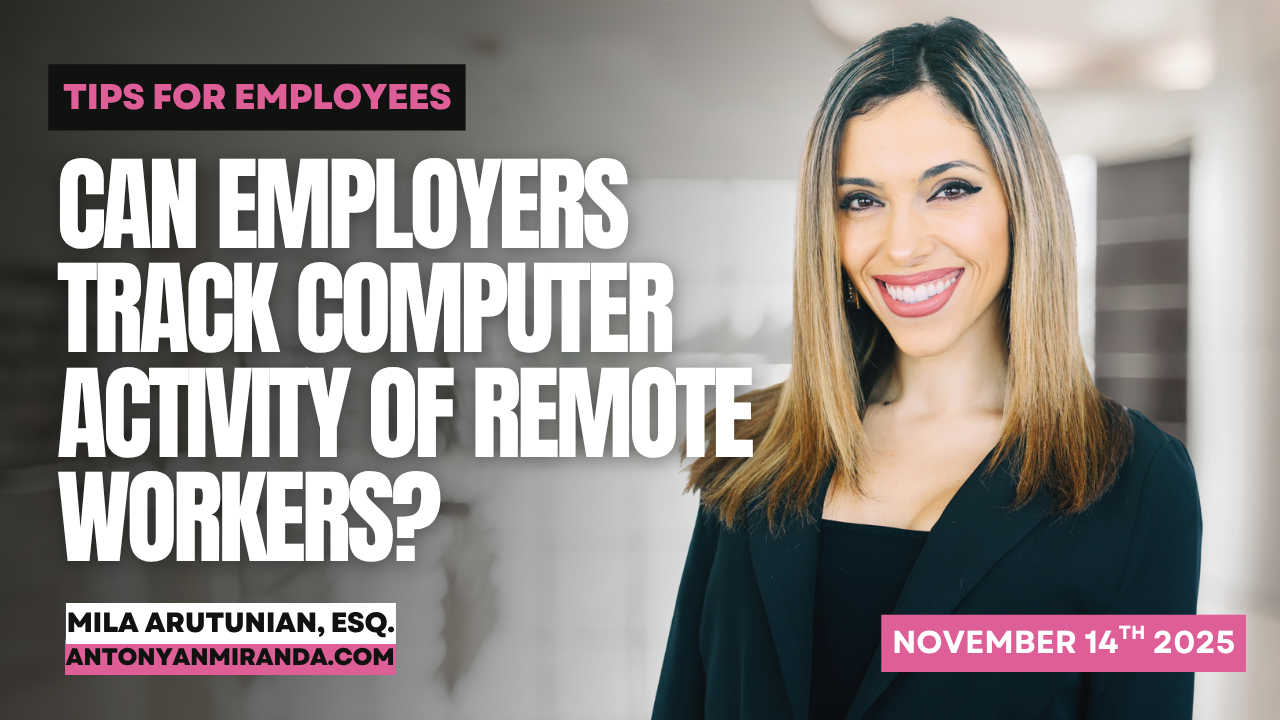
Working from home comes with a lot of perks... But it also comes with one big modern-day mystery: Is your employer allowed to track what you're doing on your computer?
As remote work has become more commonplace, it has also opened the door to increased employer monitoring. Courts have began hashing out these issues to provide guidance for employers and employees alike.
In short, yes, your employer can monitor you — but no, they don't have unlimited power.
And there’s a BIG difference between legal productivity monitoring and creepy overbearing behavior.
In California, employers generally can monitor activity on company-owned devices, even if you are working from home. That includes:
Communications made on an employer’s system are ordinarily considered company property, and California courts have recognized that employees typically have a limited expectation of privacy on employer-owned devices.
In short, if you’re using a company laptop, company email, or company communication systems, your employer generally can monitor activity on those devices—even if you’re working from your couch.
That means your employer can legally see your work emails, messages in platforms like Slack or Teams, websites you visit on the work device, your keystrokes or activity levels, and even productivity metrics like how long you were “idle,” when you logged in, and how quickly you respond to messages. I
But that’s not the end of the story, because California also has some of the strictest privacy protections in the country—and those protections apply to remote workers too.
California doesn’t let employers do anything they want just because they provide the laptop. Three major legal protections come into play.
First, California’s Constitution gives every resident a right to privacy—even in the workplace. That right kicks in when an employee has a reasonable expectation of privacy and the employer’s monitoring goes too far. So if an employer installs secret monitoring software, tries to read private emails, or accesses a webcam without warning, that can cross the line into unconstitutional territory.
Second, the California Invasion of Privacy Act (CIPA) prohibits employers from secretly recording communications. That includes things like recording calls, audio, or video without permission. Remote or not, if your employer activates monitoring tools without telling you—and especially if those tools capture audio, video, or personal communications—they may be violating the law.
Third, California’s consumer privacy laws—the CCPA and CPRA—give employees the right to know what data is being collected about them, why it’s being collected, and how it’s being used. Employers must provide a privacy notice explaining their monitoring practices. If they are tracking you but never gave you a privacy notice describing it? That’s a problem.
California doesn’t require your employer to get your explicit “yes” before monitoring your work activity. But they do have to tell you what they’re monitoring, how the information will be used, and whether any tracking tools are being installed on your devices.
That notice often comes through a handbook, a remote-work policy, an acknowledgment form, or a CCPA privacy notice.
If your employer never told you they were tracking you, that may be illegal.
Many remote employees have experienced productivity-tracking software that measures active time, idle time, screen usage, message response times, website categories, or even takes periodic screenshots.
In California, this type of monitoring is generally legal as long as: the company has told you; and the monitoring is reasonably connected to running the business.
But it becomes unlawful or problematic if the monitoring is too intrusive. Tracking that captures your personal passwords, monitors your personal phone, listens through your microphone, activates your webcam, or digs into non-work accounts crosses the line.
Monitoring can also become illegal if it is used in discriminatory ways—for example, if an employer tracks women, pregnant employees, disabled workers, or employees who take protected breaks more aggressively than others.
And monitoring absolutely cannot be used to punish employees for exercising their legal rights, such as taking meal and rest breaks, using sick leave, requesting accommodations, or reporting harassment or discrimination.
Even with all this monitoring, employers still have to follow California’s wage and hour laws.
If an employer uses monitoring tools to track "productivity," they must still:
If tracking software punishes employees for taking legally required breaks, that can lead to wage claims under the Labor Code.
If something feels off—if you suddenly discover new software on your laptop, or if the monitoring seems unusually invasive—it’s important to act.
Here’s what you need to do:
If the tracking feels retaliatory, discriminatory, secret, or overly intrusive, it may violate California’s Constitution, CIPA, the CCPA/CPRA, FEHA, or wage and hour laws. An employment attorney can help evaluate whether your employer has crossed the legal line.
California does allow employers to track what you do on company devices, even from home—but only if the monitoring is transparent, reasonable, and not invasive. Secret tracking, monitoring your personal devices, snooping into private communications, or targeting specific employees for harsher monitoring is not just inappropriate—it can be illegal.
Remote workers have strong privacy rights in California. If your employer isn’t respecting those boundaries, you may have legal recourse. If you think you may have claims, e-mail me directly at Emilia@antonyanmiranda.com to discuss your best course of action moving forward. The first consultation is always free.
Call us at 619-696-1100 to speak with one of our concierge attorneys or visit us or send us an email.










402 W Broadway. Twenty-First Floor
San Diego, CA 92101
Mobile: 619.696.1100
Email: info@antonyanmiranda.com




All rights reserved Antonyan Miranda, LLP 2025 | Disclaimer | Privacy Statement